Is UV Bad for Your Nails or Skin? A Simple Guide to UV Lamps, Cancer Myths & Wattage

This post contains affiliate links. I may earn a small commission if you shop through them — at no extra cost to you.
When I still offered in-person nail services, one of the questions I got all the time was: “Are UV lamps actually safe?” With so many TikTok videos talking about UV damage, cancer risks, SPF, and aging hands, it’s totally normal to feel a little worried.
But here’s the good news: current research shows that UV/LED lamps used for nails expose your skin to very low levels of UV – far less than what you get from natural sunlight. According to Harvard Health, a 2014 study found that even biweekly gel manicures “do not appear to significantly increase cancer risk.” Dermatologists at MD Anderson Cancer Center also note that UV nail lamps emit relatively low levels of UVA, especially compared to tanning beds or daily sun exposure.
That said, “low risk” doesn’t mean zero risk. A newer 2023 study from UC San Diego found that UV-nail dryers can cause DNA damage in isolated human cells – which is why simple precautions like sunscreen or UV gloves are still smart if you do gel nails often.
If you love doing gel nails at home (or getting gel manicures at the salon), you’ve probably heard all kinds of warnings about skin cancer, aging, or whether SPF is enough. I promise, we’re going to make this super easy to understand.
If you’re new to gel nails or want to make sure you’re doing them correctly, I walk through my full process in How To Do Your Own Gel Nails At Home Like A Pro (Step-by-Step).
In this post, I’ll break everything down in simple, non-scary terms:
• Are UV lamps harmful?
• Do they increase cancer risk?
• Should you wear sunscreen or gloves?
• What’s the difference between UV and LED lamps?
• And how do you actually choose the right wattage so your gel cures properly?
Let’s walk through the facts so you can keep doing your nails safely and confidently.
1. Are UV Nail Lamps Actually Safe? Here’s What the Research Says
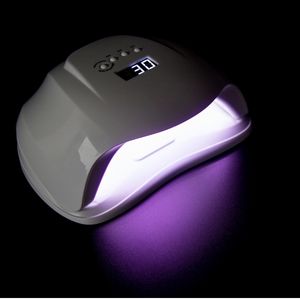
UV nail lamps – both UV and LED versions – mainly emit UVA light, the same type of ultraviolet light that reaches your skin when you go outside. Unlike UVB (the one that burns), UVA penetrates deeper and can contribute to skin aging and, over time, DNA changes.
So is this dangerous?
According to Harvard Health, a 2014 study measuring UVA output from 17 nail lamps showed that a single gel manicure doesn’t appear to pose a significant cancer risk, and even biweekly gel manicures fall into the “low risk” category when used as intended.
Dermatologists at MD Anderson Cancer Center also say that UV nail lamps emit relatively low levels of UVA, especially compared to tanning beds or even daily outdoor sun exposure. In their review, UV lamps for nails “don’t appear to be a serious concern” for most people.
In short:
- The UVA dose from a lamp is real,
- but it’s far lower than what you get from everyday sun exposure,
- and occasional gel manicures are considered low risk by most dermatology experts.
2. Can UV Nail Lamps Cause Cancer? Clearing Up the Fear
This is the question everyone wants answered – and the research is more nuanced than social media makes it seem.
What older research says:
A 2020 review in the International Journal of Dermatology looked at melanoma cases on the hands and found only two cases possibly linked to nail lamps over many years – with no clear evidence that the lamps were the direct cause. The authors also noted that population data hasn’t shown a rise in hand melanoma despite the growing popularity of gel manicures.
This suggests that, historically, UV nail lamp use has not correlated with higher rates of skin cancer on the hands.
What newer research says:
This is where things get more interesting.
A 2023 study from UC San Diego exposed human and mouse skin cells to a UV-nail dryer and found:
- DNA damage
- Increased reactive oxygen species (ROS)
- Mutations similar to those seen in skin cancers
This study raised a lot of concern online – and understandably so.
But:
It was done in vitro – meaning on isolated cells in a dish. These conditions often involve far longer exposures than a typical manicure and don’t reflect how living skin repairs itself.
Even the researchers themselves note that their findings do not prove that UV nail lamps cause cancer in humans but indicate a possible risk with repeated exposure over many years.
Full paper: https://www.nature.com/articles/s41467-023-35876-8
So what’s the takeaway?
- No human study has proven that UV nail lamps cause cancer.
- Laboratory evidence suggests that repeated, long-term UVA exposure from nail dryers could damage skin cells.
- Most dermatologists still describe the overall risk as low, especially for occasional gel users – but not zero.
This is why simple protection – like sunscreen or UV-protective gloves – is smart, especially if you do gel nails often.
3. Protecting Your Skin: How to Minimize Any Potential Risk
Even though the overall risk from UV nail lamps is considered low, taking a few simple precautions can dramatically reduce UVA exposure – and dermatologists widely recommend them.
Here are the easiest, most effective ways to protect your skin:
- Apply SPF 30+ (broad spectrum) to the tops of your hands 15–20 minutes before curing.
- The Skin Cancer Foundation recommends applying sunscreen before using UV nail dryers to block UVA radiation.
- Wear UV-protective manicure gloves (the fingerless kind with UPF fabric).
- Dermatologists say UV-blocking gloves provide reliable protection and significantly reduce UVA exposure.
- Avoid extra curing time – cure only for the recommended seconds.
- The Cleveland Clinic notes that over-curing won’t strengthen your gel manicure, it just increases UVA exposure unnecessarily.
- Take breaks between gel sets if you do them often. A lot of nail damage actually comes from improper removal, not the lamp itself, I break this down step by step in Step-by-Step: Remove Your Gel Nails at Home (With and Without Acetone).
- Small breaks or alternating with regular polish helps lower cumulative UVA exposure, which experts suggest is key for long-term skin health.
4. UV Lamp vs. LED Lamp: What’s Actually the Difference?
Most lamps today are marketed as LED, but they still cure gel using UV-A light, just delivered in a different (and more efficient) way. Both UV and LED lamps cure gel because gel polish contains photoinitiators that react to UV wavelengths.
Here’s how they differ:
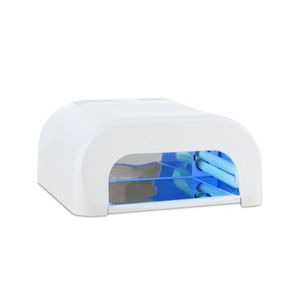
UV Lamps (older style)
- Use fluorescent UV bulbs
- Emit broad-spectrum UVA, including wavelengths outside what gel needs
- Cure slower (often 2+ minutes per layer)
- Bulbs need replacing as they lose power over time
- Produce more heat and run less efficiently
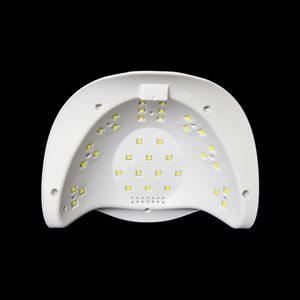
LED UV Lamps (modern standard)
- Use LED bulbs that emit specific UV wavelengths (typically 365–405 nm)
- Cure gels faster (usually 30–60 seconds)
- More energy-efficient
- Produce lower heat spikes
- Bulbs last significantly longer and don’t need replacing
Because LED lamps use narrower, targeted wavelengths, they cure gel more efficiently with less wasted UV output.
LED UV lamps are the new standard – they’re faster, more efficient, and offer lower unnecessary UV exposure than old-style fluorescent UV lamps. If you’re buying a lamp today, choose an LED UV lamp, not a traditional UV bulb model.
5. Wattage: 24W? 48W? 80W? How to Choose the Best UV/LED Lamp
Choosing a UV/LED lamp can feel confusing – especially when every lamp claims to be the “strongest,” “fastest,” or “professional grade.” But here’s the truth: wattage alone doesn’t determine how well a lamp cures gel.
Professional nail educators emphasize that what really matters is a combination of wattage, LED quality, wavelengths, and LED placement, not the biggest number on the box.
Let’s break down what each factor means and how to choose the right lamp.
What Wattage Actually Means
Wattage = power consumption, not UV strength.
Higher wattage does not automatically mean a better or safer cure. It does not directly tell you how “strong,” “safe,” or “high-UV” a nail lamp is – a common misconception. What truly affects curing is:
- Overall LED quality
- Number of LEDs
- Placement of the LEDs
- Wavelengths (nm)
Wattage still matters for efficiency, but it is not the main indicator of curing power.
So what does wattage actually do?
Wattage still matters because it affects how efficiently a lamp can deliver enough UV output to cure gel evenly.
- Higher wattage = faster, more consistent curing
- Extremely high wattage (96W+) = usually unnecessary marketing hype
- Low wattage (<36W) = often leads to under-curing
- Wrinkles
- Chips within days
- Lifting
- Dented builder gel
- Premature breakdown of the gel’s structure
- Higher risk of allergies from uncured product
What Actually Matters When Choosing a Lamp
1- Dual Wavelengths (365–405 nm)
Gel polish contains photoinitiators that react to specific UV wavelengths. Lamps with both 365 nm + 405 nm cure all gel types more evenly and quickly.
Single-wavelength lamps may result in:
- stickiness
- lifting
- slower curing
2- 20–36 High-Quality LED Beads
The number of LEDs is more important than wattage. More LED beads = more even curing.
Avoid lamps with LEDs only on the top – this creates shadows and leads to inconsistent results.
3- Even LED Placement (Top + Sides)
LEDs should wrap around the inside of the lamp to cure the sides of nails and thumbs properly. Uneven placement is one of the biggest causes of:
- soft gel
- uncured cuticle areas
- builder gel dents
4- Functional Wattage (48–80W)
Wattage should be balanced with the total number of LEDs and wavelengths.
You want enough power to cure reliably – not an inflated wattage with weak LEDs.
Nail science education generally recommends:
- 48–54W → Best for most home users
- 60–80W → Best for builder gel or thick layers
- 96W+ → Mostly marketing hype
- Under 36W → Often under-cures gel → chips, wrinkles, lifting
5- Built-In Timers (30s, 60s, 90s)
Timers help prevent over-exposure and ensure consistent curing, which dermatologists recommend. Auto-sensors are a bonus for convenience.
6- Low-Heat / “Soft Cure” Mode
Perfect for builder gel or sensitive nails.
The lamp starts at a lower intensity and gradually increases to avoid heat spikes.
Bottom Line
The “best” UV/LED lamp is not the highest wattage – it’s the one with:
- 365–405 nm dual-wavelength LEDs
- 20–36 high-quality LED beads
- Even distribution LED beads around the lamp
- Auto sensor + timers
- Reliable features like timers and low-heat mode.
A good lamp will cure your gel evenly without needing excessive exposure time – which is better for your nails, your results, and your skin.
6. My Recommended UV/LED Lamps
If you’re looking for a reliable UV/LED lamp for at-home gel nails, here are solid options based on curing consistency, proper LED placement, and overall performance:
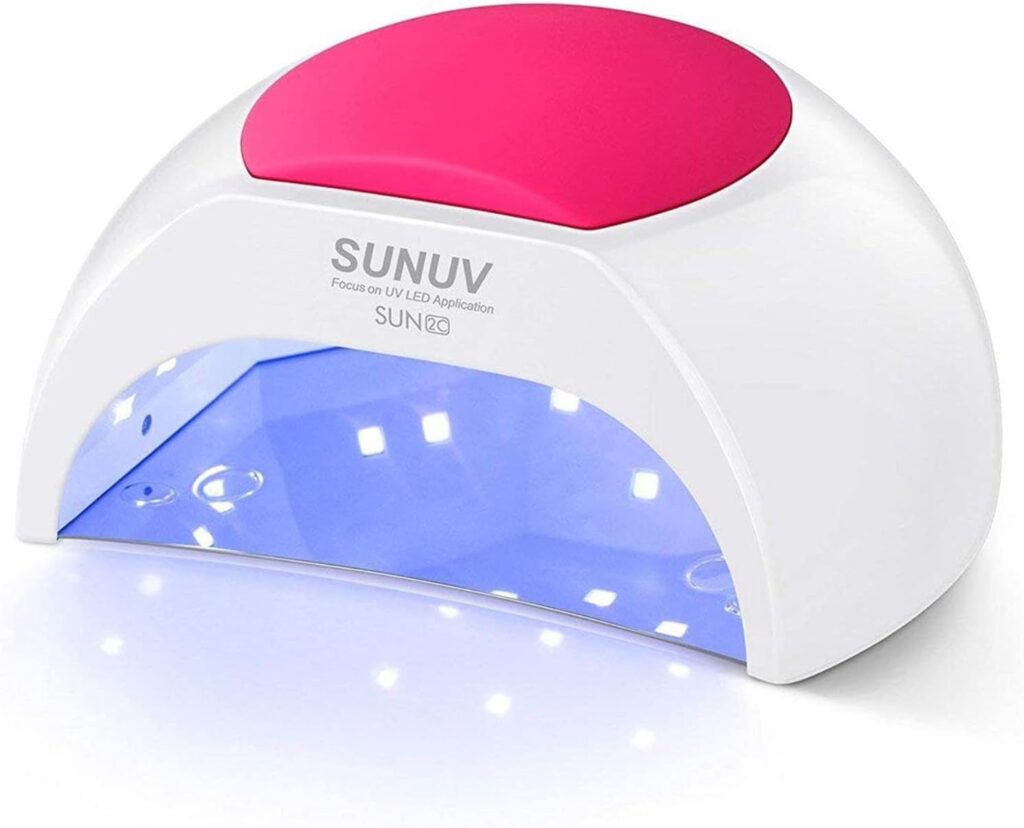
Best Overall (for All Gel Types): SUNUV SUN2C or SUNUV SUN3 LED UV Lamp
Why it’s great:
- Dual-wavelength 365+405 nm
- Even LED placement across top + sides
- Consistent curing for both gel polish and builder gel
- Long-time favorite in the nail community
Perfect for: regular gel polish, DIY users, and reliable everyday gel manis.
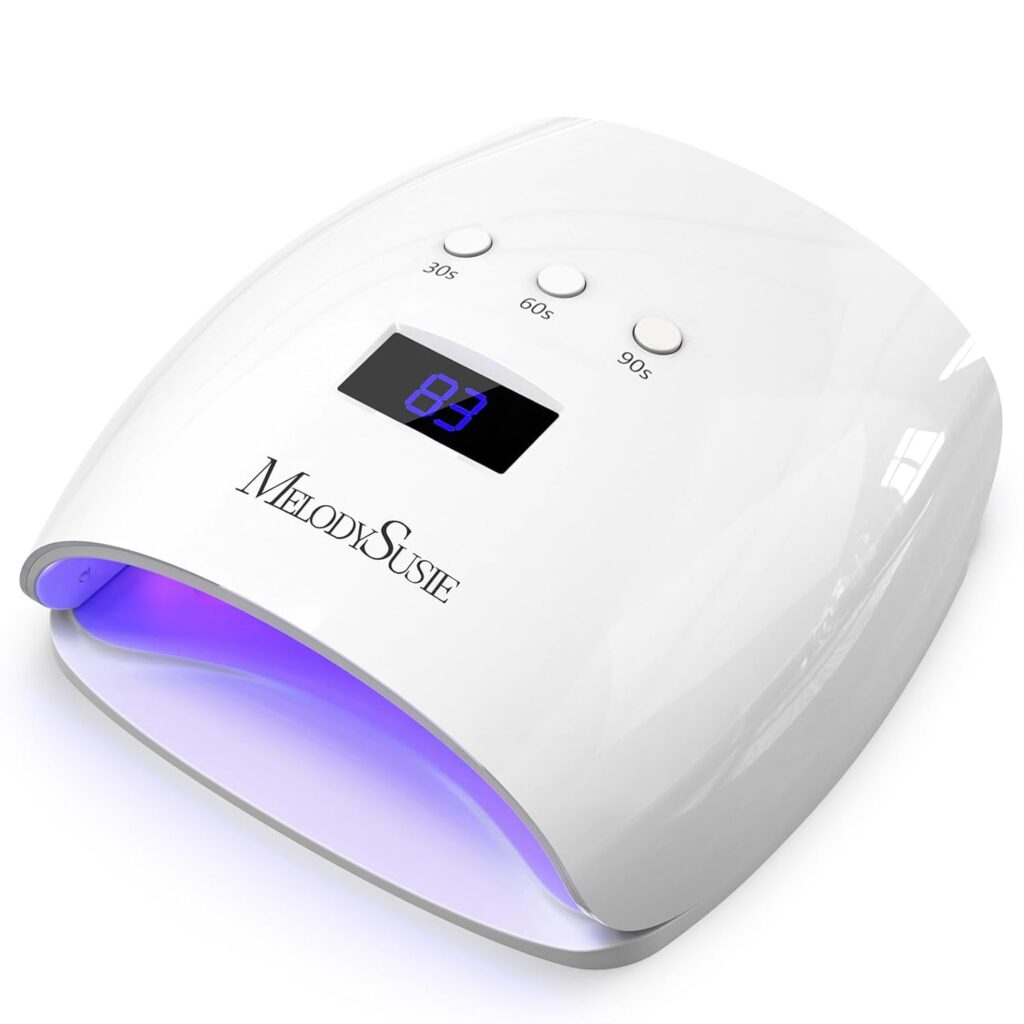
Best for Builder Gel & Thicker Products: MelodySusie 54W Pro Nail Lamp
Why it’s great:
- Designed to handle builder gel, hard gel, and thicker layers
- Strong and even curing without needing excessive exposure time
- Low-heat mode to reduce heat spikes
- Durable, professional-grade quality
Perfect for: Apres Gel-X, builder gel, hard gel, thicker applications.
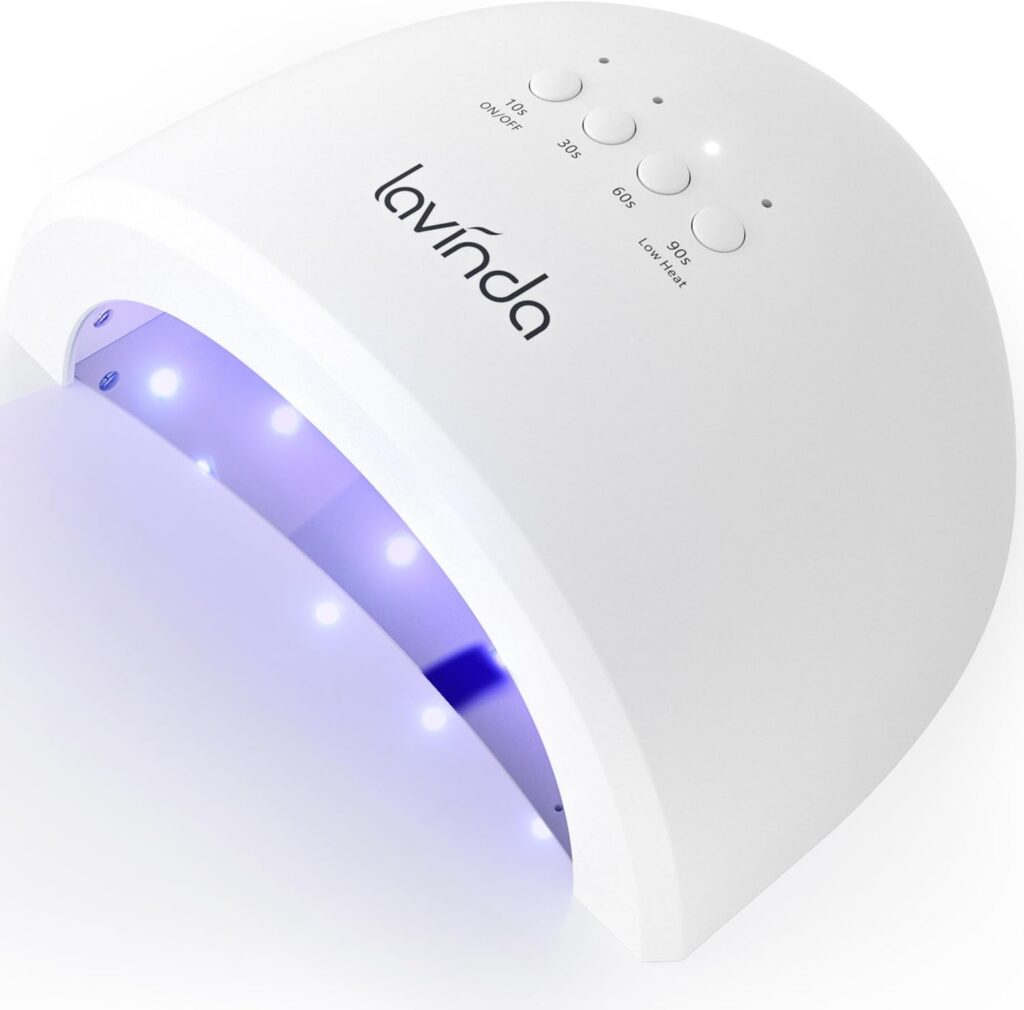
Best Budget (Beginner-Friendly & Reliable): Lavinda 48W LED UV Nail Lamp
Why it’s great:
- Simple, lightweight, cures evenly
- Dual-wavelength
- Works perfectly with regular gel polish, including Beetles and other beginner brands
- Great first lamp for beginners or casual DIY-ers
Perfect for: starter gel kits, beginners, basic gel polish applications.
Final Thoughts: Should You Worry?
UV nail lamps do emit UVA light, which is associated with skin aging and long-term DNA damage. However, current human studies have not found a strong or direct link between gel manicures and skin cancer.
Newer lab research shows that UV nail dryers can damage cells when exposure is repeated under controlled lab conditions, so there is still reason to be mindful.
Dermatologists describe the overall risk as low, particularly for occasional gel users – but not zero, especially for people who get gels frequently over many years.
If you enjoy gel nails, you don’t need to stop. Just protect your skin with sunscreen or gloves, avoid unnecessary exposure, and choose a well-designed LED-UV lamp that cures efficiently.